
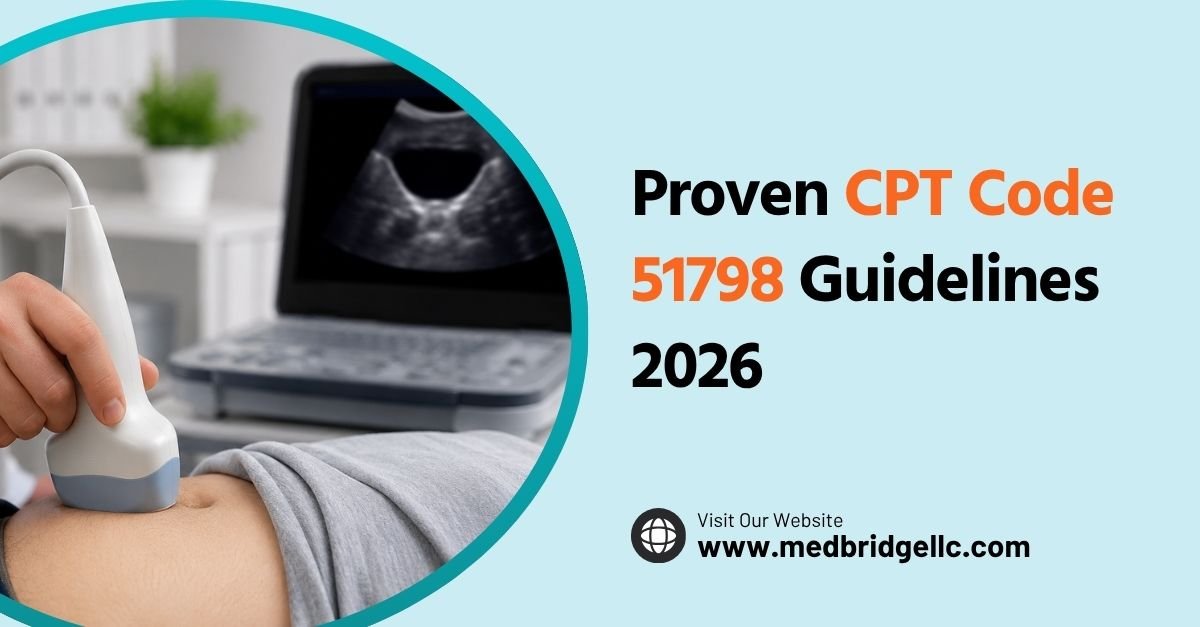

If you work in a urology practice or any outpatient setting that measures post-void residual urine volume, CPT Code 51798 is probably on your fee schedule. It’s a straightforward ultrasound measurement code but straightforward doesn’t mean simple to bill correctly.
Here’s the problem most practices run into. Because 51798 is a non-invasive, quick procedure, it gets treated as an afterthought in the documentation process. The measurement gets done, the number gets noted somewhere in the chart, and nobody gives much thought to whether it was billed, whether the documentation actually supports the claim, or whether the payer even reimbursed it at all. That’s revenue walking out the door on every single encounter where it happens.
What is CPT Code 51798?
CPT Code 51798 is used to report the ultrasonic measurement of post-void residual (PVR) urine volume and/or bladder capacity using a bladder scanner.
Simply put, this is the code that is to be billed when using an ultrasound of the bladder to determine the volume of residual urine in the bladder after a patient has voided.
This procedure can be performed in a multitude of clinical circumstances. Patients who have problems with urinary retention, benign prostatic hyperplasia (BPH), neurogenic bladder, overactive bladder, incontinence evaluations or even just post-operatively, when a physician needs to measure the volume of emptying of the bladder – this is when you use this code.
This procedure takes only two minutes. A trained clinician places a handheld ultrasound device on the patient’s lower abdomen after voiding, the device calculates the residual volume, and the result is documented. No catheterization, no contrast, no lengthy setup.
Because CPT 51798 is frequently performed in urology and outpatient practices, accurate documentation and billing are essential to prevent missed reimbursement opportunities.
Who Performs and Bills CPT Code 51798?
CPT 51798 is most commonly billed by urology practices, but it’s not exclusive to urology. Any qualified provider who measures with appropriate equipment can bill it, including:
- Urologists and urology APPs
- Primary care providers managing urinary symptoms
- Gynecologists and urogynecologists
- Geriatric medicine practices
- Rehabilitation medicine providers managing neurogenic bladder
- Home health agencies in certain circumstances
The key requirement isn’t the specialty. It’s that the procedure was actually performed, that the appropriate equipment was used, that the results were interpreted by a qualified provider, and that it’s documented correctly in the medical record.
One thing worth clarifying upfront: the bladder scan device has to be owned or leased by the billing entity. If you’re using a device that belongs to the facility or hospital, you generally cannot bill 51798 under the professional fee schedule the facility bills the technical component instead.
CPT Code 51798 Documentation Requirements 2026
This is where most denials originate. The procedure gets done, the result gets scribbled in a note, and the claim goes out but the documentation doesn’t actually support what was billed. Here’s what needs to be in the record to support a clean CPT Code 51798 claim.
Clinical Indication
The note needs to state why the post-void residual measurement was performed clearly. What is the patient’s diagnosis? What symptom or clinical question prompted the measurement? “PVR measured 180cc” is not sufficient documentation. “Post-void residual measured to evaluate urinary retention in the context of BPH with lower urinary tract symptoms” tells a payer exactly why this procedure was necessary.
The diagnosis code you bill alongside 51798 matters too. Common supporting diagnoses include:
| ICD-10 Code | Description |
|---|---|
| N40.1 | Benign prostatic hyperplasia with lower urinary tract symptoms |
| R33.9 | Retention of urine, unspecified |
| N39.0 | Urinary tract infection |
| N31.9 | Neuromuscular dysfunction of the bladder |
| N32.81 | Overactive bladder |
| R39.14 | Feeling of incomplete bladder emptying |
Using a vague or mismatched diagnosis code is one of the fastest ways to get this claim denied or flagged for review.
Description of the Procedure
Your note should document that a post-void bladder ultrasound scan was performed. Include the type of device used if your practice has a standard, and note that the patient had voided immediately before the measurement. The timing matters some payers want to see that the measurement was taken within a reasonable window after voiding, typically within five to ten minutes.
The result
Document the actual post-void residual volume in milliliters. This sounds obvious, but claims get denied because the number is in a flow sheet that wasn’t attached to the claim, or it’s buried in nursing notes that the reviewing auditor never found. The result needs to be clearly documented in the provider’s note.
Interpretation and Clinical Significance
The provider needs to document what the result means in the context of this patient’s care. A PVR of 30 cc in a patient with mild BPH symptoms has different clinical significance than a PVR of 350 cc in a post-surgical patient. Document your interpretation and how it informs the treatment plan. This is what separates a defensible claim from a bare-minimum one.
Can CPT 51798 be billed with an office visit on the same day?
Yes, with the right approach. This is one of the most common questions practices have about this code, and it’s also a common source of denied claims when it’s not handled correctly.
If you perform a bladder scan during the same encounter as an evaluation and management visit, you can bill both but you need modifier 25 on the E&M code to indicate that a separately identifiable evaluation and management service was performed on the same day as the procedure.
Without modifier 25, many payers will bundle the E&M into the 51798 payment and you’ll lose the office visit reimbursement entirely. This is a very common billing error in urology practices, and it happens on a significant percentage of visits where both services are rendered.
The E&M also needs to be documented as a distinct, separately identifiable service. If the entire note is about the bladder scan result and nothing else, a payer reviewer is going to question whether a separate E&M was actually warranted. The office visit note should reflect a broader clinical encounter history, assessment, and plan with the bladder scan documented as a supporting procedure.
Bundling Rules and What to Watch for
CPT Code 51798 has specific bundling considerations that vary by payer and that are defined in the National Correct Coding Initiative (NCCI) edits. Here are the ones that come up most often.
51798 and urodynamic studies. If a comprehensive urodynamic study is performed on the same date, the post-void residual measurement is typically included in that evaluation and cannot be billed separately. Review your NCCI edits carefully if you’re performing urodynamics alongside 51798.
51798 and cystoscopy. Some payers consider bladder scan measurement to be included in a cystoscopy performed the same day, particularly if the clinical indication overlaps. Know your payer-specific policies here before billing both on the same date of service.
51798 was billed multiple times on the same day. Some payers allow 51798 to be billed more than once in a single encounter if clinically warranted. For example, a pre-void and post-void measurement, or measurements taken at different points during a urodynamic evaluation. But this requires clear documentation of the clinical reason for multiple measurements and is subject to payer-specific rules.
Common denial reasons for CPT 51798 and how to fix them
Lack of medical necessity. This is the most common denial. The payer reviews the claim and either the diagnosis code doesn’t support the procedure, or the documentation doesn’t explain why the measurement was clinically necessary.
Fix: Make sure your diagnosis coding is specific and your notes clearly document the clinical indication.
Missing or insufficient documentation. The procedure happened but the record doesn’t show it clearly enough.
Fix: Implement a documentation checklist for CPT Code 51798 indication, procedure performed, result, interpretation, and clinical plan. Make it a standard part of every bladder scan note.
Bundled with a higher-complexity service. If 51798 is being denied consistently on days when other procedures are also billed, check the NCCI edits for those procedure pairs.
Fix: Review your bundling rules, use appropriate modifiers when unbundling is permitted, and know which combinations simply can’t be billed separately.
Equipment not owned by the billing provider. If you’re renting time on a facility’s device rather than using your own, the technical component belongs to the facility.
Fix: Clarify your equipment arrangement and bill only the component you’re entitled to.
Frequency limitations exceeded. Some payers have policies on how frequently PVR measurements can be billed for the same patient within a given timeframe. Fix: document the medical necessity for each measurement and know your payer’s frequency policies.
Frequently Asked Questions
Is CPT 51798 covered by Medicare?
Yes, CPT code 51798 is a covered procedure under Medicare when it is medically indicated and well-documented.
Does CPT 51798 require a physician to perform the scan?
The scan itself can be performed by trained clinical staff. A medical assistant, nurse, or technician but the results must be reviewed and interpreted by the billing provider, and the provider must document that interpretation in the medical record. The billing is under the provider’s NPI, which means the provider takes responsibility for the clinical accuracy and documentation of the result.
Can 51798 be billed for telehealth visits?
No. CPT Code 51798 requires a physical measurement using ultrasound equipment in the presence of the patient. It cannot be billed for telehealth encounters.
How often can CPT 51798 be billed for the same patient?
There’s no universal limit, but frequency is subject to medical necessity review. If you’re billing 51798 for the same patient at every visit, your documentation needs to clearly justify why repeated measurements are clinically necessary at each encounter. Routine or reflexive ordering without a documented clinical indication is the fastest way to trigger a payer audit on this code.
Conclusion
Documentation, accurate coding for diagnosis, and payer-specific guidelines are necessary for CPT code 51798 to be billed effectively. Healthcare professionals who follow these guidelines will benefit from lower denial rates and higher revenues.
Do you need professional assistance with bladder scans billing? Learn more about our Urology Billing Services and see how we will help your practice enhance revenue with optimized billing processes.