
Prostheses Medical Billing Services
Med Bridge LLC provides prostheses billing services for prosthetists, orthotic and prosthetic practices, and O&P suppliers, handling accurate CPT/ICD-10/HCPCS coding, L-code billing, payer-specific documentation, and denial recovery. Get a free billing analysis.
Prostheses billing is a world of its own. L-codes, K-levels, functional necessity documentation, and payer-specific coverage criteria make it one of the most detail-heavy billing specialties in healthcare. One wrong L-code, one missing functional assessment, or one incomplete physician note and you are looking at a denial or a demand for recoupment. Med Bridge LLC takes the entire prostheses revenue cycle off your plate, from eligibility checks through denial appeals, so you get paid for the devices you provide.
Schedule Your Free Demo
Increase your prostheses collections with accurate, reliable billing. Talk to a prostheses billing specialist today.
15+ years in medical billing
200+ O&P Clients Served
40+ certified coders
HIPAA Compliant
Prostheses Medical Billing & Coding Services
Med Bridge LLC
Prostheses Billing Service Specifications
Complete field-by-field overview for prostheses practices
| Service Type | Prostheses Medical Billing & Revenue Cycle Management |
|---|---|
| Practices Served | Prosthetists, orthotic and prosthetic practices, O&P suppliers, independent prosthetic labs, hospital-based prosthetic departments, multi-location O&P groups |
| Services Covered | Upper extremity prostheses, lower extremity prostheses, microprocessor knees, myoelectric prostheses, sockets, liners, suspension systems, prosthetic feet, component replacements, repairs, adjustments, diagnostic evaluations |
| Coding Systems | CPT, ICD-10, HCPCS — with expertise in L-code billing, K-level assignment, functional necessity documentation, and payer-specific prosthetic coverage criteria |
| Pricing | Percentage of collections no hidden fees, no setup charges |
| EHR/PMS Compatibilit | Epic, Cerner, athenahealth, NextGen, Allscripts, OPIE, Futura, MedFlex, Practice Fusion |
| Compliance | HIPAA-compliant, SOC 2 Type II certified |
97.3%
Clean Claim Rate
27
Days Avg. A/R
4.7%
Denial Rate
48-hour
Claim Turnaround
Contact: Mon–Fri, 8 AM–6 PM CT | (888) 378-7709
Get a Free Billing AnalysisWhat Is Prostheses Medical Billing?
Prostheses medical billing covers the full revenue cycle for O&P practices, including eligibility verification, charge capture, CPT/ICD-10/HCPCS coding, claim submission, payment posting, and denial management. Prostheses billing is different from standard DME or general orthotics billing because L-codes, K-levels, functional documentation requirements, and payer-specific coverage criteria require specialized billing workflows.
L-Code Billing
Prosthetic devices are billed using HCPCS L-codes. Each component including sockets, liners, suspension systems, feet, knees, and hands has its own L-code, and the code must match the device provided.
K-Level Assignment
K-levels (K0–K4) describe a patient's functional potential and help determine which prosthetic components are covered. Documentation must support the K-level assigned.
Functional Necessity Documentation
Payers require documentation showing that the prosthesis is functionally necessary. This may include a physician's order, functional assessment, and clinical notes supporting the patient's need for the device.
Payer-Specific Coverage Criteria
Medicare, Medicaid, commercial payers, and workers' compensation programs can have different prosthetic coverage requirements. Some may require prior authorization, specific functional assessment tools, or other documentation.
Prior Authorization for Prosthetic Devices
Many prosthetic devices require prior authorization before delivery. Tracking authorization requirements and approval periods helps prevent coverage issues and denied claims.
Repairs, Adjustments, and Replacements
Repairs, adjustments, and replacements have their own codes and coverage requirements. Accurate coding and documentation are essential for proper reimbursement.
Bundling and NCCI Edits
Prosthetic components may have applicable bundling and NCCI edit rules. Proper review helps determine when services are bundled and when an appropriate modifier may be required.
Medicare and Medicaid Prosthetic Billing
Medicare and Medicaid have their own prosthetic coverage requirements. Medicare requires supporting documentation, while Medicaid requirements can vary by state.
Staffing Challenges at O&P Practices
Many O&P practices operate with small administrative teams. Clinical staff may manage billing alongside patient fittings and device adjustments, increasing the risk of missed claims, authorization lapses, and rising A/R.
Prostheses Revenue Cycle Management Process
Every claim goes through a five-step process designed to help prevent denials before they happen.

Eligibility & Insurance Verification
We verify coverage, co-pays, deductibles, and prosthetic-specific benefit requirements before the device is ordered. Real-time checks flag coverage gaps, authorization requirements, and inactive plans.

Charge Capture
Every service including upper and lower extremity prostheses, microprocessor knees, myoelectric prostheses, sockets, liners, suspension systems, prosthetic feet, replacements, repairs, adjustments, and diagnostic evaluations is converted into billable line items with appropriate L-code application and K-level tracking.

Prostheses-Specific Coding
Certified coders apply CPT, ICD-10, and HCPCS codes with prosthetic billing requirements, including L-codes, K-levels, and functional necessity documentation.

Claim Scrubbing & Submission
Before submission, claims are reviewed for L-code errors, K-level mismatches, authorization gaps, NCCI edits, bundling issues, and missing documentation.

Payment Posting & Remittance Reconciliation
ERA/EOB posting is matched against expected reimbursement. Underpayments are identified and appealed rather than simply written off.

Denial Management & Appeals
Denials are worked within 24–48 hours. Appeals include clinical documentation, functional assessments, coding rationale, and regulatory citations. Denial reasons are tracked to identify recurring root causes.
Eligibility Verification
We verify coverage, co-pays, deductibles, and prosthetic benefits before ordering. Real-time checks flag gaps, authorization needs, and inactive plans.

Prostheses-Specific Coding
Certified coders apply CPT, ICD-10, and HCPCS codes with prosthetic billing requirements, including L-codes, K-levels, and functional necessity documentation.

Payment Posting
ERA/EOB posting is matched against expected reimbursement. Underpayments are identified and appealed rather than simply written off to protect every dollar owed.


Charge Capture
Every service, from prostheses and microprocessor knees to sockets, liners, repairs, and adjustments, is converted into billable line items with accurate L-codes and K-level tracking.

Claim Scrubbing & Submission
Before submission, claims are reviewed for L-code errors, K-level mismatches, authorization gaps, NCCI edits, bundling issues, and missing documentation.
Prostheses Service & Specialty Coding Services
Each prosthetic device category is handled as its own workflow with specific coding, documentation, authorization, and coverage requirements.
Upper Extremity Prostheses Billing
Upper extremity prostheses, including hands, wrists, elbows, and shoulders, have specific L-codes and coverage criteria. We manage the required coding and documentation.
Microprocessor Knee Billing
Microprocessor knees have specific L-codes, K-level requirements, and functional documentation needs. We manage the coding and authorization requirements.
Socket, Liner & Suspension System Billing
Sockets, liners, and suspension systems each have their own L-codes and coverage rules. We manage the applicable coding and billing requirements.
Medicare & Medicaid Prosthetic Billing
We manage the coding, documentation, and authorization requirements associated with Medicare and Medicaid prosthetic billing.
Lower Extremity Prostheses Billing
Lower extremity prostheses, including feet, ankles, knees, and hips, have specific L-codes and K-level requirements. We handle the applicable coding and documentation.
Myoelectric Prostheses Billing
Myoelectric prostheses have specific L-codes and coverage criteria. We manage the coding and documentation requirements for these devices.
Repair, Adjustment & Replacement Billing
Repairs, adjustments, and replacements have specific codes and coverage rules. We manage the coding and documentation requirements for these services.
Diagnostic Evaluation Billing
Diagnostic evaluations for prosthetic fitting have specific CPT codes and documentation requirements. We manage the applicable coding and billing requirements.
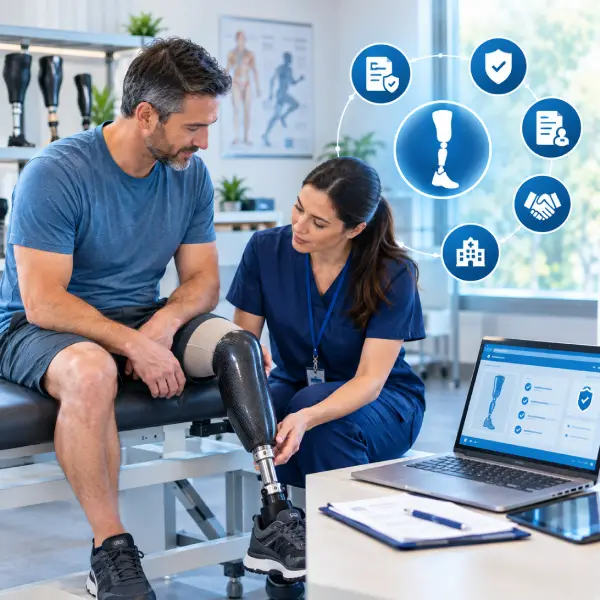
Prosthetic Prior Authorization & Compliance
Prior authorization is a key part of prosthetic billing. Many devices require authorization before delivery, so accurate authorization tracking is essential for reimbursement.
Services That Commonly Require Prior Authorization
Upper extremity prostheses
Lower extremity prostheses
Microprocessor knees
Myoelectric prostheses
Component replacements, depending on the payer
Repairs and adjustments, depending on the payer
How Med Bridge LLC Handles Prior Authorization
Real-time eligibility and authorization tracking
Prior authorization requests supported by required payer documentation
Authorization tracking to help prevent approval expiration before device delivery
Follow-up on pending authorizations to help prevent delivery delays
Compliance with the CMS Interoperability and Prior Authorization final rule for turnaround times
Compliance Monitoring
HIPAA-compliant workflows and data security
Documentation audits for L-code billing, K-level assignment, and functional necessity claims
Payer-specific rule tracking for prosthetic coverage, repairs, and replacements
Annual coder training on CPT updates and O&P coding changes
Why Choose Med Bridge LLC for Prostheses Billing Services?
Prostheses-Specific Certified Coders
Our coders are certified (CPC, CCS) and work in O&P billing. They understand L-codes, K-levels, functional necessity documentation, and payer-specific prosthetic coverage criteria.
Faster Reimbursement
97.3% clean claim rate | 27-day average A/R 48-hour claim turnaround These are the supplied Med Bridge LLC performance metrics across 20+ O&P clients.
Data Security & Compliance
SOC 2 Type II certified and HIPAA-compliant workflows support secure billing operations, audit trails, and regular reporting.
Scalable Billing Support
Our workflows can support solo prosthetists, multi-location O&P groups, and hospital-based prosthetic departments.
Prostheses Billing Performance Metrics
These numbers come from the supplied Med Bridge LLC content for active O&P clients.
0
Days
Average Days in A/R
0
Hours
Claim Turnaround Time
0
%
Clean Claims Rate
14- 0
%
Average Collections Increase
0
%
Denial Rates
0
%
Prior Authorization Approval
0
%
Payment posting accuracy
0
%
First-pass acceptance rate
Precision Medical Billing and Coding for Modern Healthcare Practices

In-House vs. Outsourced Prostheses Billing Costs
| Cost Category | In-House Billing | Med Bridge LLC Outsourced |
|---|---|---|
| Biller salary + benefits | $50,000–$70,000 / year | — |
| Billing software + clearinghouse | $7,000–$15,000 / year | Included |
| O&P Coding Training | $3,000–$6,000/year | Included |
| Denial write-offs | 6–11% of revenue | 4.7% denial rate |
| Total annual cost | $65,000–$95,000+ | Percentage of collections no hidden fees |
| Net annual savings | — | $30,000–$55,000+ |
Frequently Asked Questions About Prostheses Billing
Prostheses billing involves L-codes, K-level assignment, functional necessity documentation, payer-specific coverage criteria, and prior authorization requirements.
Yes. We handle upper extremity prostheses, lower extremity prostheses, microprocessor knees, myoelectric prostheses, sockets, liners, suspension systems, prosthetic feet, component replacements, repairs, and adjustments.
Monthly dashboards can include clean claim rate, A/R days, denial rate by payer, claim turnaround time, K-level distribution, and collections by device category.
Denials are worked within 24–48 hours. Appeals include clinical documentation, functional assessments, coding rationale, and regulatory citations. Denial reasons are tracked to identify recurring issues.
Med Bridge supports Epic, Cerner, athenahealth, NextGen, Allscripts, OPIE, Futura, MedFlex, and Practice Fusion.
Pricing is a percentage of collections. The supplied content states there are no setup fees, software fees, or hidden charges.
We track authorization requirements by payer, submit requests with supporting documentation, and monitor approval expiration dates to help prevent coverage gaps before device delivery.
The supplied content states that most O&P practices are fully onboarded within 30–45 days, including EHR access, payer enrollment, L-code setup, and prosthetic coding configuration.