
FQHC Medical Billing Services
Med Bridge delivers FQHC billing services for federally qualified health centers, look-alikes, and community health centers, handling prospective payment system (PPS) claims, sliding fee documentation, and payer-specific billing requirements. Get a free billing analysis.
FQHC billing is not the same as standard medical billing. The prospective payment system, sliding fee schedules, bundled visit rules, and Medicare/Medicaid-specific requirements create a billing environment that general billing companies are not equipped to handle. One missed qualifying visit, one incorrect PPS rate, or one undocumented sliding fee discount, and your center is leaving reimbursements on the table or facing compliance issues. Med Bridge manages the entire FQHC revenue cycle, from eligibility verification through denial appeals, so your team can focus on patient care.
Schedule Your Free Demo
Increase your fqhc collections with accurate, reliable billing. Talk to a fqhc billing specialist today.
15+ years in medical billing
100+ FQHC Clients Served
40+ certified coders
HIPAA Compliant
FQHC Medical Billing & Coding Services
Med Bridge LLC
FQHC Medical Billing Service Specifications
Complete field-by-field overview for fqhc practices
| Service Type | FQHC Medical Billing & Revenue Cycle Management |
|---|---|
| Centers Served | Federally qualified health centers, FQHC look-alikes, community health centers, rural health clinics, migrant health centers, homeless health centers, public housing primary care centers |
| Services Covered | Primary care visits, preventive care, chronic disease management, behavioral health, dental services, substance use disorder treatment, prenatal care, pediatric care, telehealth visits, case management |
| Coding Systems | CPT, ICD-10, HCPCS — with expertise in FQHC PPS billing, qualifying visit criteria, sliding fee schedule application, Medicare and Medicaid FQHC rules, and bundled visit coding |
| Pricing | Percentage of collections no hidden fees, no setup charges |
| EHR/PMS Compatibility | Epic, Cerner, eClinicalWorks, athenahealth, NextGen, Allscripts, OCHIN, eCW FQHC configurations |
| Compliance | HIPAA-compliant, SOC 2 Type II certified, FQHC-specific compliance monitoring |
97.8%
Clean Claim Rate
24
Days Avg. A/R
4.1%
Denial Rate
48-hour
Claim Turnaround
Contact: Mon–Fri, 8 AM–6 PM CT | (888) 378-7709
Get a Free Billing Analysis
What Is FQHC Billing?
FQHC billing refers to the specialized revenue cycle process for federally qualified health centers. These centers receive cost-based reimbursement through the prospective payment system (PPS) or an alternative payment methodology (APM). That means the billing rules are different from standard fee-for-service billing. The visit must qualify for FQHC payment. The rate must reflect the correct PPS amount. The sliding fee discount must be documented properly. And the payer mix Medicare, Medicaid, commercial, and self-pay each has its own FQHC-specific rules.
Prospective Payment System (PPS)
FQHCs are reimbursed through PPS, which pays a single rate per qualifying visit rather than paying separately for each service. That rate is adjusted annually and varies by geographic location. Billing the wrong rate or missing a qualifying visit means lost revenue. Billing a non-qualifying visit under PPS means a denial or a compliance concern.
Qualifying Visits
Not every encounter qualifies for FQHC payment. A qualifying visit must be a face-to-face encounter with a qualifying practitioner, and it must meet specific criteria. Preventive services, chronic care visits, and behavioral health sessions may qualify. But telephone calls, prescription refills, and certain non-face-to-face services do not. Knowing which visits qualify and which do not is essential to accurate FQHC billing.
Sliding Fee Schedule
FQHCs are required to offer a sliding fee discount program based on patient income and family size. The discount must be documented, and the billing must reflect the correct discounted amount. If the sliding fee is not applied correctly, the center may be out of compliance with HRSA requirements. If it is applied but not documented, the claim may be denied.
Bundled Visit Rules
FQHC billing bundles many services into the PPS rate. That means you cannot bill separately for services that are already included in the qualifying visit. But some services — like dental, behavioral health, and certain preventive screenings may be billed separately under specific circumstances. Understanding the bundling rules prevents duplicate billing and denials.
Medicare and Medicaid FQHC Rules
Medicare and Medicaid each have their own FQHC billing requirements. Medicare pays under the PPS, but with specific rules for preventive services, telehealth, and mental health visits. Medicaid FQHC rules vary by state, and some states use an APM instead of PPS. Tracking these differences is a daily requirement.
Payer Mix and Credentialing
FQHCs serve a diverse patient population, which means a diverse payer mix. Commercial payers, Medicare, Medicaid, and self-pay patients each have different billing rules. Credentialing gaps can cause denials that look like coding errors but are actually enrollment issues.
Our FQHC Revenue Cycle Management Process
Every claim goes through a six-step process designed to stop denials before they happen not chase them after.

Eligibility & Insurance Verification
We verify coverage, co-pays, deductibles, and FQHC-specific benefit requirements before the patient arrives. Real-time checks flag coverage gaps and inactive plans the same day.

Charge Capture
Every qualifying visit primary care, preventive care, behavioral health, dental, substance use treatment gets turned into billable line items with correct PPS rate application and sliding fee documentation. No missed charges, no unbilled qualifying visits.

FQHC-Specific Coding
Certified coders apply CPT, ICD-10, and HCPCS codes with FQHC rules in mind: qualifying visit criteria, PPS rate assignment, sliding fee discount application, and bundled service rules. Every code ties back to documentation that supports it.

Claim Scrubbing & Submission
Before anything leaves the system, we catch PPS rate errors, qualifying visit mistakes, sliding fee documentation gaps, and payer-specific FQHC rule violations. Clean claims go out within 24 hours.

Payment Posting & Remittance Reconciliation
ERA/EOB posting gets matched against expected PPS reimbursement. Underpayments get appealed not written off.

Denial Management & Appeals
Denials get worked within 24–48 hours. Appeals go out with clinical documentation, coding rationale, and FQHC-specific regulatory citations. We track why denials happen so we can fix the root cause upstream.
Eligibility Verification
We verify coverage, co-pays, deductibles, and FQHC-specific benefit requirements before the patient arrives. Real-time checks flag coverage gaps and inactive plans the same day.

FQHC-Specific Coding
Certified coders apply CPT, ICD-10, and HCPCS codes with FQHC rules in mind: qualifying visit criteria, PPS rate assignment, sliding fee discount application, and bundled service rules.

Payment Posting
ERA/EOB posting gets matched against expected PPS reimbursement. Underpayments get appealed, not written off, protecting your revenue and reducing losses.

Charge Capture
Every qualifying visit primary care, preventive care, behavioral health, dental, substance use treatment gets turned into billable line items with correct PPS rate application and sliding fee documentation. No missed charges, no unbilled qualifying visits.

Claim Scrubbing & Submission
Before anything leaves the system, we catch PPS rate errors, qualifying visit mistakes, sliding fee documentation gaps, and payer-specific FQHC rule violations. Clean claims go out within 24 hours.
FQHC Service & Specialty Coding Depth
General billing companies treat FQHC billing like standard medical billing. We treat each service line as its own workflow with its own FQHC-specific rules.
Primary Care & Preventive Services Billing
Primary care visits, annual wellness visits, and preventive screenings each have their own qualifying visit criteria under FQHC rules. We make sure every qualifying visit is billed at the correct PPS rate.
Dental Services Billing
Dental services in an FQHC may be billed separately from the PPS rate, but the rules vary by payer. We handle the dental coding and billing requirements that FQHCs need.
Chronic Care Management Billing
Chronic care management services may qualify for FQHC payment or may be billed separately. We handle the coding and documentation requirements for chronic care management in an FQHC setting.
Behavioral Health Billing
Behavioral health visits may qualify for FQHC payment or may be billed separately, depending on the payer and the state. We handle the coding and billing rules that apply to mental health and substance use disorder services.
Telehealth Billing
FQHC telehealth claims have specific qualifying visit rules, POS coding requirements, and payer-specific policies. We track telehealth rules as they change.
Sliding Fee & Self-Pay Billing
Sliding fee discounts must be documented and applied correctly. We handle the sliding fee schedule application, patient income verification, and self-pay billing rules that FQHCs need.
Prior Authorization & Compliance
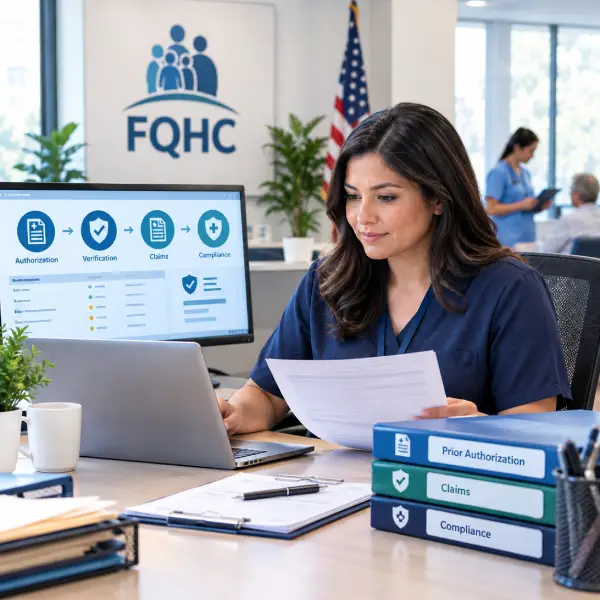
Prior authorization matters for FQHC services, referrals, and specialty medications. We treat it as a core part of the job.
Services that commonly require prior auth:
Specialist referrals
Advanced imaging (MRI, CT, PET)
Specialty medications
Outpatient procedures
Behavioral health intensive services
How we handle it:
Real-time eligibility and authorization tracking we know which payers require auth, which don't, and which have their own clinical criteria
Prior auth requests submitted with documentation that meets payer criteria the first time
Referral tracking so authorizations don't expire before the appointment
Follow-up on pending authorizations so care doesn't get delayed
Compliance with the CMS Interoperability and Prior Authorization final rule for turnaround times
Compliance monitoring:
HIPAA-compliant workflows and data security
Documentation audits to keep qualifying visit billing, PPS rate assignment, and sliding fee application defensible
Payer-specific rule tracking for FQHC billing, telehealth, and preventive services
Annual coder training on CPT updates and FQHC coding changes
Why Choose MedBridge for FQHC Billing Services?
FQHC-Specific Certified Coders
Our coders are certified (CPC, CCS) and work in FQHC billing not standard medical billing. They know PPS rules, qualifying visit criteria, sliding fee documentation, and bundled visit coding.
Faster Reimbursement
97.8% clean claim rate. 24-day average A/R. 48-hour claim turnaround. These aren't marketing numbers they're our actual performance metrics across 100+ FQHC clients.
Data Security & Compliance
SOC 2 Type II certified. HIPAA-compliant. We keep rigorous audit trails and send regular reports so you always know where your money stands.
Scales With Your Center
Single-site FQHC? Multi-location network? Look-alike? Our workflows scale without changing your EHR or adding staff. Schedule your free billing audit today
FQHC Billing Results & Performance Metrics
These numbers reflect our active fqhc client base. We don't publish aspirational benchmarks we publish results.
0
Days
Average Days in A/R
0
Hours
Claim Turnaround Time
0
%
Clean Claims Rate
14- 0
%
Average Collections Increase
0
%
Denial Rates
0
%
Prior Authorization Approval
0
%
Payment posting accuracy
0
%
First-pass acceptance rate
Precision Medical Billing and Coding for Modern Healthcare Practices

In-House vs. Outsourced FQHC Billing
| Cost Category | In-House Billing | Med Bridge Outsourced |
|---|---|---|
| Biller salary + benefits | $50,000–$70,000 / year | — |
| Billing software + clearinghouse | $7,000–$15,000 / year | Included |
| FQHC Coding Training | $3,000–$6,000/year | Included |
| Denial write-offs | 6–11% of revenue | 4.1% denial rate |
| Total annual cost | $65,000–$95,000+ | Percentage of collections no hidden fees |
| Net annual savings | — | $30,000–$55,000+ |
Frequently Asked Questions
FQHC billing uses the prospective payment system, which pays a single rate per qualifying visit rather than paying separately for each service. It also involves sliding fee documentation, bundled visit rules, and Medicare/Medicaid-specific requirements that standard billing companies are not equipped to handle.
Yes. We work with federally qualified health centers, FQHC look-alikes, community health centers, rural health clinics, migrant health centers, homeless health centers, and public housing primary care centers.
You get monthly dashboards: clean claim rate, A/R days, denial rate by payer, claim turnaround time, qualifying visit volume, and collections by service line. We also run ad-hoc reports for specific payers or service categories.
Denials get worked within 24–48 hours. Appeals include clinical documentation, coding rationale, and FQHC-specific regulatory citations. We track denial reasons so we can fix root causes upstream especially qualifying visit errors and PPS rate mistakes.
Epic, Cerner, eClinicalWorks, athenahealth, NextGen, Allscripts, and OCHIN. If you use something else, we can work with your existing workflow or suggest an integration.
Pricing is a percentage of collections. No setup fees. No software fees. No hidden charges. You pay when you get paid.
We track authorization requirements per payer, submit requests with documentation that meets criteria, and monitor referral deadlines so authorizations don't expire. We follow the CMS Interoperability and Prior Authorization final rule for turnaround times.
Most FQHCs are fully onboarded within 30–45 days. We handle the transition from your current billing company or in-house team, including EHR access, payer enrollment, PPS rate setup, and FQHC coding configuration.for
Maximize Your FQHC Revenue With Smarter Billing
Reduce denials, capture every eligible reimbursement, and stay compliant with complex FQHC billing requirements. Partner with experienced FQHC billing specialists to keep your revenue cycle running smoothly.